
ClimatePlan is sponsoring AB 2560, authored by Assemblymember Nick Schulz from Burbank, to codify the Climate Action Plan for Transportation Infrastructure (CAPTI) into law. This bill ensures that CAPTI’s framework continues beyond Governor Newsom’s administration and guides California’s future transportation investments.
CAPTI is California’s most important climate policy across the state’s transportation agencies. It lays out a strategy for discretionary funding to deliver climate, health, safety, and equity outcomes. It has already had a major impact, steering funding in discretionary programs away from costly and polluting highway projects and toward investments in transit, light rail, and walking and biking infrastructure.
Many ClimatePlan organizations have been involved since CAPTI’s development and remain deeply invested in its success. Codifying CAPTI would not only require Caltrans and the California Transportation Commission to consider its principles when investing in projects, but also serve as a public commitment to public transit, walking and biking, and electric vehicles at a crucial time. We offer full support for this bill.
What AB 2560 Does
AB 2560 would codify CAPTI’s 10 guiding principles, which lay out how California should invest in projects that create new clean transportation options for people and goods. The principles cover a range of topics, including: prioritizing sustainable transportation projects, infill housing, conservation, vehicle electrification and equity.
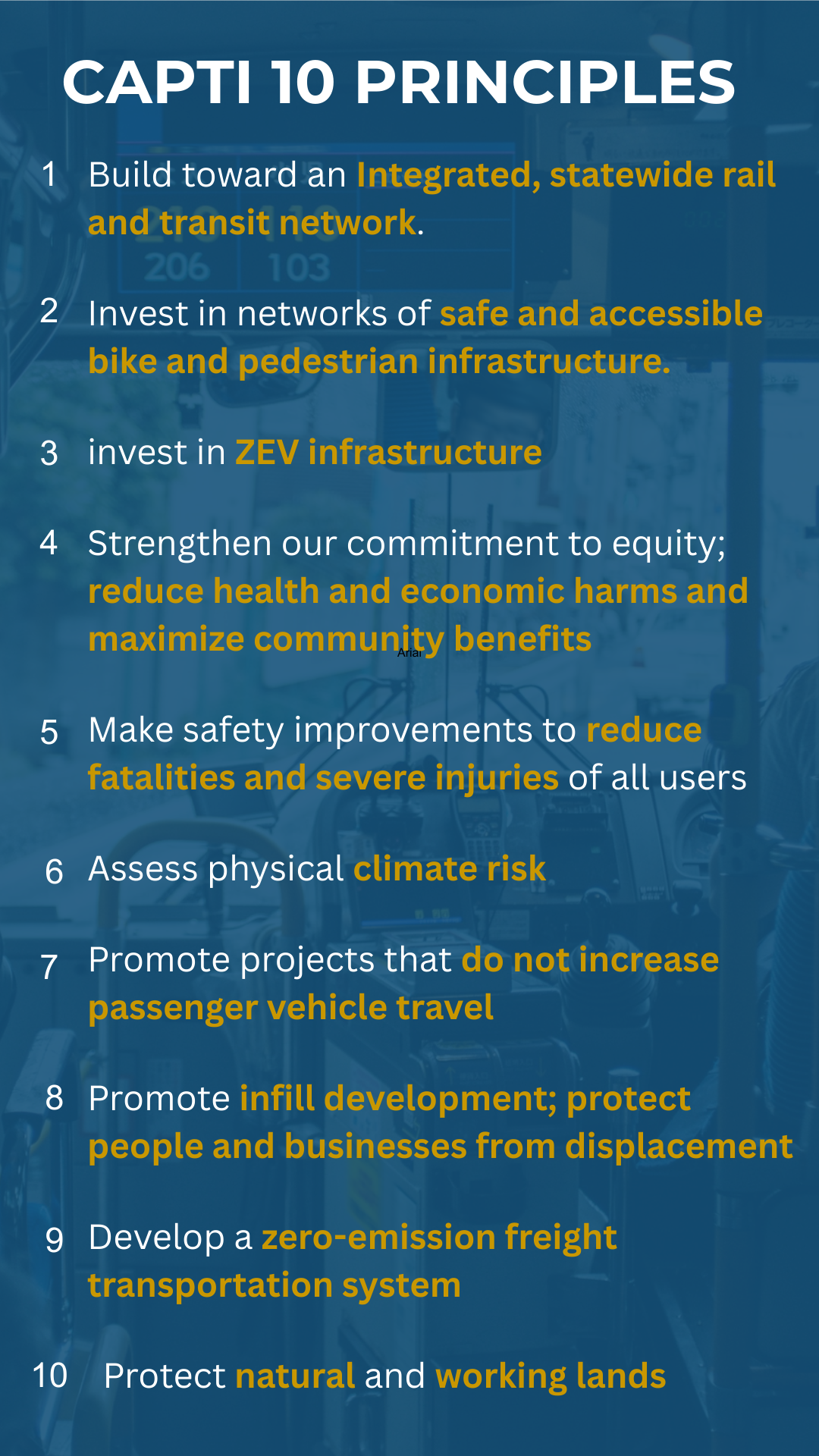
10 CAPTI principles abridged
AB 2560 would also codify the requirement for certain funding programs to align priorities with the CAPTI goals, including: the Interregional Transportation Improvement Program, Transit and Intercity Rail Capital Program, Local Partnership Program, Trade Corridor Enhancement Program, Solutions for Congestion Corridors Program, and the Active Transportation Program.
History of CAPTI
CAPTI was developed in response to Governor Newsom’s calls to action issued through Executive Orders in 2019 and 2020. The orders directed California’s transportation agencies to tie investments to climate goals and identify near-term actions focused on zero-emission vehicles and projects that reduce driving. CAPTI built on the ‘fix it first’ approach required by SB1, adding new areas of focus, including multi-modal travel, climate resilience, and equity.
The first CAPTI was published in 2021, establishing the 10 guiding principles and providing a framework for investment decisions. As the state moved quickly to implement CAPTI’s recommendations, the California State Transportation Agency (CalSTA) published an updated version in 2025 (CAPTI 2.0), extending the focus to planning, programming, project delivery, and operations.
CAPTI’s Achievements
CAPTI has achieved a lot in a short time. Its recommendations have been implemented quickly by Caltrans, and progress has been made on all 14 recommendations from CAPTI 2. A 2024 study by the Mineta Institute for Transportation at San Jose State University estimated that discretionary transportation infrastructure investments made by the State of California now generate only one-fifth the greenhouse gas emissions compared to investments made during prior administrations.
CAPTI has also:
Changed policies and funding guidelines, funneling billions into multimodal projects
Created the Equity Advisory Committee to advise the California Transportation Commission (CTC)
Launched innovative projects like Highways to Boulevards, though the funding for this program was retracted last year
Created the Caltrans System Investment Strategy (CSIS) to ensure recommended projects align with CAPTI principles
Why It Matters That We Keep CAPTI
While CAPTI has resulted in major policy and funding changes, much of the work is still in progress. Without continued support, the next administration could slow or reverse progress.
Codifying CAPTI through AB 2560 would require Caltrans and CTC to consider its 10 principles in investment decisions. It also signals a public commitment—legislators reaffirming something that would otherwise be a single administration’s priority. This helps ensure Californians benefit from cleaner air, safer streets for walking and biking, and better access to reliable public transit.
We fully support AB 2560 and encourage lawmakers to pass it, keeping California’s transportation system moving toward a cleaner, safer, and more equitable future.